
Is your work life more complicated, cluttered, and disorganised than you would Like?
Do you ever find yourself tangled up with dormant projects…
… half-completed undertakings?
Workers in factories, retail, and offices have tasks to complete, and they tick them off, one after another…. …Then they get some more.
But in this world we are our own managers.
Too much freedom can be stifling. We pick our own deadlines… but this often means they are not deadlines at all(!)

And if the work doesn’t go out the door it never feels completely complete
We can’t really move on when we are psychologically and practically tethered to old work.
We will always get confused, distracted and overwhelmed, sidelined from doing our best work if we have half-a-dozen embryonic, half-finished, or mostly-finished projects all competing for our attention
They were all once exciting novel endeavours, but somehow warped into little procrastination burrows offering refuge whenever our current project stalls.
Ship it or scrap it: Get it off your desk
Sometimes literally, but also psychologically. Clear the decks.
To focus on something literally means to concentrate one’s efforts on something to the exclusion of other things.
You can’t focus on everything. Your cognitive bandwidth is finite
Be an incredibly effective laser, not a very poor floodlight.
A tree that never get pruned never bears fruit.

Living an adult life is complicated enough. Our working life, at least, is a domain where we can exercise control.
Don’t allow it to grow convoluted and labyrinthine.
Keep it clean and focused.
The trap of half-finished work
When I return to the original work I might never recover the same excitement, I may no longer feel its pulse.
I am left wondering whether it can be salvaged, or if its time has passed.
The Zeigarnik Effect
He studied waiters in restaurants who were all able to remember tables’ orders in detail, until they were served. Then it disappeared from their minds.
This Zeigarnik effect explains how songs get stuck in our heads, unless we play them to the end.
And it also explains why old projects haunt us: until we complete or kill them, they rattle around in our heads like unpaid bills.

The Zeigarnik effect works against us whenever we move on from one project to another without closing the door.
Dangling threads create mental drag. Like a ship’s hull accumulating barnacles and seaweed.
Roy Baumeister’s ‘decision fatigue’ and the ‘cognitive load’ theory support the same: Constantly juggling half-finished projects saps energy, and makes it harder to finish anything. Attention is finite. Spread it too thin and nothing blooms.
At any time we encounter one of our old sinkholes – dormant but technically still ‘live’ – we can be bounced back to recovering and rediscovering the great stuff we did in the past and bringing it back to life before hitting another wall
Probably the same wall as we hit last time!
So we turn our attention to some other masterpiece-in-waiting…
They make us still less likely to finish the NEXT one. Our experiences define us as ‘hoarders’ not as ‘creators’. And that is how we behave.
Why didn’t you finish it?
Maybe it was unfinished for practical reasons…
(no time, or another book was published that made ours seem derivative, or we learned there’s no market for fish-alien-pop-star-fiction…)
…Maybe it was perfectionism…
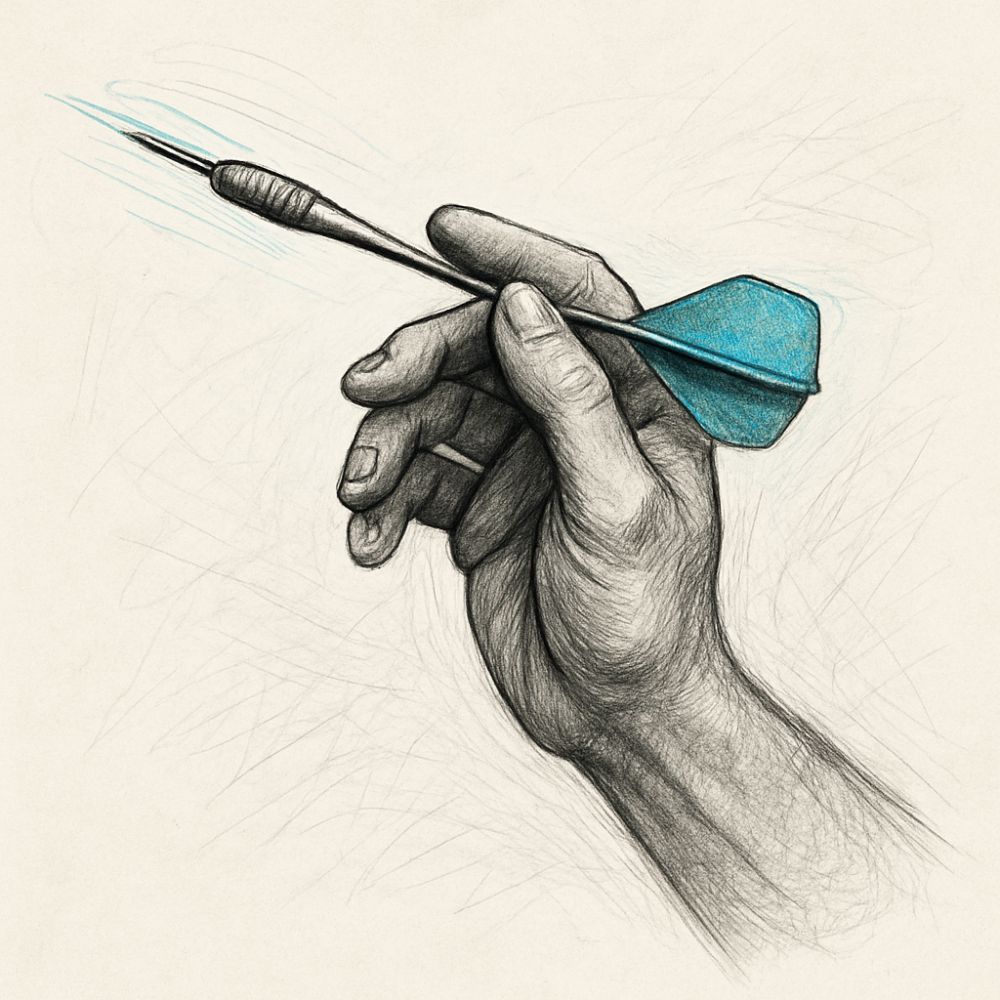
(fear of letting go of the dart, a determination to spot every crack & to polish out every imperfection – which is actually a never-ending process, so if you can’t break that habit you might as well reconcile yourself to a career working on the same text for eternity)
…Maybe some psychological reason…
(some shadow work: fear of failure, fear of success, fear of audience reception, fear of upsetting your nan)
…But the symptom of these is the same – These undead vampire projects draining our energy…
…And the cure is common too.
Sunlight.
Drag them out and – by the cold light of day – evaluate them – either archive them or publish them – Get shot of them out the front door or the back.
Courage to let go
Rick Rubin, in The Creative Act, reminds us that the artist’s job is to channel. We are stewards of ideas, not their jailers. Artists are more like midwives who deliver ideas into the world when the time comes.
As Seth Godin Insists:
“Ship. Because the cost of not shipping is that you will never learn what the market has to say“
Why delay?
You cannot afford a paucity mindset when it comes to ideas – there will be more – if you allow yourself the headspace.
Don’t jealously guard your latest idea as if it were the only winning lottery ticket. Have a clear out, make space for more. Keep the work ticking over. Maya Anjelou (as usual) said it beautifully and succinctly: